If your business runs on WhatsApp, you have already outgrown the free app
A whatsapp business api nigeria setup is not something only big companies use. If you run a hotel in Lekki, a school in Ibadan, a clinic in Port Harcourt, or an e-commerce store in Abuja, and your customers find you through WhatsApp — you have already outgrown the free app.
Picture this: It is 9 AM at a boutique hotel on the island. The phone is on the charger, green notification bubbles stacked from the night before. Three different guests have asked about check-in time. A travel agent sent a booking request. Someone is asking if the pool is open. A staff member has already replied to one of those enquiries — the wrong one — because the messages are mixed with family chats, supplier orders, and yesterday's broadcast.
That is how SMEs in Nigeria lose thousands of naira every week. Not from bad service, but from scattered chats.
If your business runs on WhatsApp, you have already hit the wall the free WhatsApp Business app cannot get you past. The free app is built for one person on one phone. Even WhatsApp Web only mirrors the phone. Once you have more than one person responding, or more than about a hundred customer enquiries a day, you are not just handling messages — you are losing leads, double-replying, forgetting follow-ups, and burning team hours on work a structured system would handle automatically.
The real question is not “should I upgrade?” It is “how much am I leaving on the table by not having a structured messaging system?”
This post walks you through exactly what the WhatsApp Business API unlocks, what it costs in real Nigerian naira, and how to get started without losing the personal touch that makes WhatsApp work for your business in the first place.
What the WhatsApp Business API actually unlocks
Many business owners hear “WhatsApp API” and picture something complicated — a developer project, a Silicon Valley tool, something that only telecoms and banks use. That is not what it is.
The WhatsApp Business API is a backend that connects your WhatsApp number to your business tools. Your customers still chat in the same green WhatsApp they have always used. They do not install a new app, learn a new interface, or notice anything different on their end. What changes on your side is the difference between night and day.
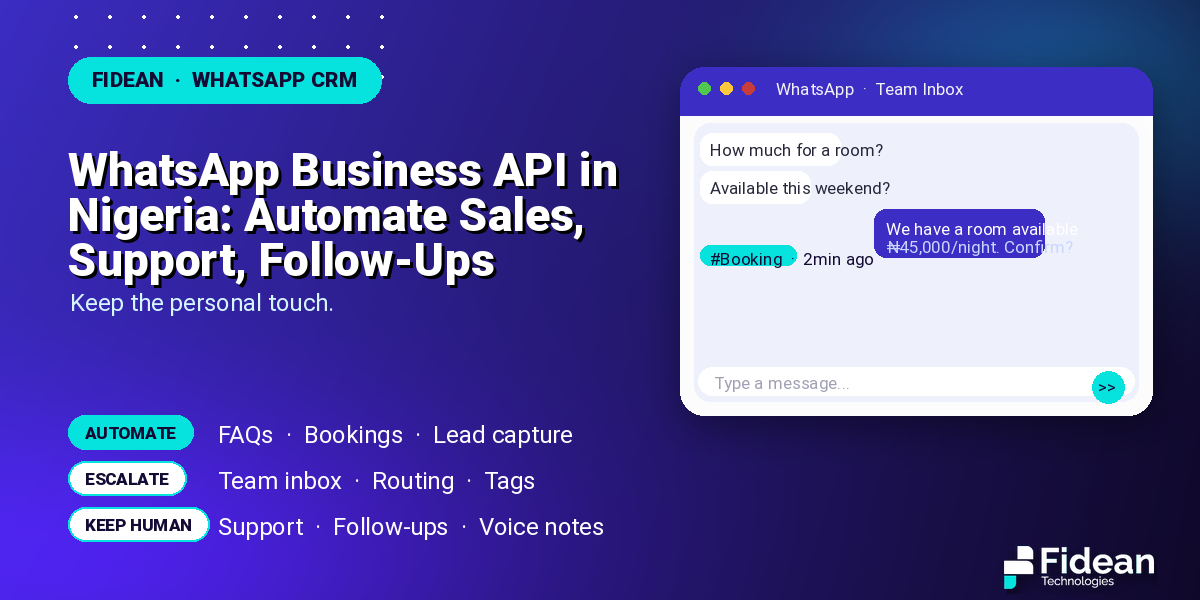
Team inbox. Multiple agents can reply from the same WhatsApp Business number. Conversations get routed, assigned, and tagged. The customer sees one business identity — not a confusing string of “which number do I message now?” The hotel receptionist handles bookings, the manager handles complaints, and both work from the same number without stepping on each other's replies.
Automated messaging. Greeting messages, away messages when the shop is closed, quick replies for the questions every customer asks — “Do you deliver?”, “What are your hours?”, “How much is the consultation fee?” These automations are not robotic. They are the first response, fast and helpful, and they free your team to focus on the conversations that need human judgement.
CRM sync. Every WhatsApp conversation gets logged with the contact's name, tags, and notes. When a returning customer messages again, you see their history — what they asked last time, whether they purchased, what stage of the conversation they are in. No more “sorry, who is this?” when a prospect follows up after three weeks.
Chatbots that actually help. A chatbot on the WhatsApp Business API is not the frustrating kind that forces customers through a maze of options. It handles the straightforward stuff: FAQs, collecting lead details (name, email, what service they need), qualifying enquiries, and handing off to a human when the question needs nuance. A school in Ibadan handling admission enquiries can have the chatbot answer “What are the requirements?” and “How much is the school fees?” in seconds, while the admissions officer only steps in for the conversations that need a personal touch.
Broadcast and campaign messaging (opt-in only). Unlike the broadcast lists in the free WhatsApp Business app that cap at 256 people and offer zero analytics, the API lets you send marketing messages to customers who have opted in — with delivery receipts, read receipts, and reply tracking. The catch: this is the marketing conversation category, and it costs per conversation. It is not spam, and it must never feel like spam. But for a business that has an actual announcement — a new product, a limited-time offer, a booking reminder — it is a channel with open rates that email marketers can only dream of.
Payment and booking integration. A customer asks about a service. The chatbot sends a Paystack checkout link. The customer pays. The system logs the payment and sends a confirmation. All inside WhatsApp. For a realtor in Abuja managing property-view requests, it means a prospect can book a viewing time without a phone call, and the system tracks who is coming and when.
What it costs in Nigeria — and what “free” misses
Pricing is the question every Nigerian SME owner asks first, and it is the most misunderstood part of the WhatsApp Business API. So let us be direct.
Meta charges per conversation, not per message. Here is how it breaks down in Nigeria:
- Service conversations — any reply you send within 24 hours of a user's last message — are free. That means most day-to-day customer support costs you nothing beyond the platform fee.
- Marketing conversations — proactive messages to opted-in contacts — cost roughly ₦90 per conversation. Meta gives every WABA 1,000 free marketing conversations per month, so a small business that sends monthly campaign messages to its customer list may not pay for marketing at all.
- Utility conversations — appointment reminders, order updates, payment confirmations — cost roughly ₦52 per conversation.
For a Nigerian SME handling 200 customer conversations per day, the monthly cost for marketing and utility conversations combined typically lands between ₦2,000 and ₦5,000, plus the Business Solution Provider (BSP) platform fee — usually $10 to $50 per month depending on the provider and features.
Compare that to the cost of a single lost lead. If a prospect messages “How much?” and gets no reply for six hours, and you never see that enquiry again, how many of those can your business afford before the cost of the API pays for itself?
The real investment is not the per-conversation fee. It is the setup: system integration, chatbot flow design, CRM connection, and the support that keeps everything running. That is where working with a local partner like Fidean makes the difference — we handle the technical setup so you do not need an in-house developer.
How to get started: from WhatsApp Business app to API in 3 steps
Getting from the free app to a working API setup is not a six-month project. It is three clear steps:
Step 1: Register a WhatsApp Business Account (WABA). You do this through a Meta-approved Business Solution Provider or an embedded CRM/inbox platform. The BSP handles the compliance checks and Meta's review process. This step takes a few days if your business documents are ready.
Step 2: Connect your customer-facing number. Yes — the same number you already use. The API does not require a new phone line. Your customers keep messaging the same number they have always used. Nothing changes on their side.
Step 3: Configure your inbox, automations, chatbot flows, and CRM connection. This is where the system becomes your system. The team inbox, greeting and away messages, the FAQ chatbot flow, the integration with your booking or payment system. This is also where a local partner adds real value — because a chatbot that understands “Na tomorrow I go come” and routes it correctly is very different from a generic template that only understands textbook English.
A practical tip from experience: do not try to automate everything on day one. Start with a greeting message, an away message, and one FAQ flow — your most-asked question. Let your team get comfortable with the inbox. Then layer on more automation as the team sees what works. The businesses that try to build a perfect bot upfront usually end up rebuilding it twice. The ones that start simple and iterate are live in a week and improving every month.
Guardrails: sending responsibly on Nigeria's dominant channel
WhatsApp is the most personal channel in Nigerian business. People keep their family group, their church group, their market association, and their supplier in the same app. Sending on WhatsApp is a privilege, not a right, and Meta enforces this strictly.
Opt-in is mandatory. You can only message people who have contacted you first or explicitly opted in. Bulk messaging without consent is the fastest way to get your WABA banned — and a banned number cannot be recovered. The number is gone.
Never use the API for spam. Every marketing conversation costs money, and even if you are willing to pay, the platform has zero tolerance for unsolicited broadcast messages. Good businesses do not need spam anyway — an opt-in list of 200 engaged customers who actually want to hear from you is worth more than 2,000 random contacts who will block and report you.
Disclose AI chatbot replies. When a chatbot responds to a customer, the first message should say something clear like: “You are speaking with an AI assistant. Type ‘human' to speak to a person.” Transparency builds trust — and it is a Meta policy requirement.
Keep a human handover path in every flow. Every automated conversation must have an escape hatch. If the chatbot does not understand the customer, or the customer is frustrated and insists on speaking to a person, the system needs to route them to a team member without asking the customer to repeat themselves. A chatbot loop that traps a frustrated customer is worse than no chatbot at all.
Account for Nigerian communication style. Customers may message in Pidgin, mix English and Yoruba or Igbo, or send a voice note. A system that only handles textbook English will miss half your conversations. The best WhatsApp setups include tone detection and flexible routing — something our team at Fidean builds into every WhatsApp implementation we deliver.
The bottom line
The WhatsApp Business API is not a toy for big companies. It is a practical tool that any Nigerian SME with more than one person responding to customers can use to stop leaking leads, reduce team hours spent on repetitive questions, and give every customer a faster, more professional experience — all while keeping the personal, chat-based feel that makes WhatsApp the platform customers actually want to use.
Whether you run a boutique hotel in Lekki, a school in Ibadan, a clinic in Port Harcourt, or an e-commerce brand in Abuja, the jump from “handling chats on one phone” to “running a structured WhatsApp inbox” is one of the highest-ROI investments a growing business can make in 2026. For more on the digital infrastructure that supports this, check out our guide to best web hosting for Nigerian small businesses.
And you do not need to figure it out alone. Talk to Fidean about setting up a WhatsApp CRM that fits your business — number onboarding, chatbot flow design, CRM and Paystack integration, and team training included. See our portfolio for examples of businesses we have helped set up digital systems that actually work in the Nigerian market.