Website maintenance services in Nigeria are no longer a “nice to have” for serious businesses. Your website is often the first place a potential customer, parent, patient, donor, investor, or partner checks before they call you. If the site is slow, broken, hacked, outdated, or showing a security warning, that visitor may not complain. They will simply leave and choose the next business that looks ready.
Many Nigerian businesses treat a website like a signboard: build it once, hang it outside, and forget it. But a website is closer to a company vehicle, office generator, payment terminal, or sales team laptop. It needs updates, checks, protection, cleaning, and occasional improvement. If you ignore it long enough, it will still cost you; the only question is whether the cost will come as routine support or as an emergency.
At Fidean Technologies, we see this pattern often. A business launches a beautiful WordPress site, celebrates the new look, shares the link for a few weeks, and then nobody checks the forms, plugins, backups, speed, SSL certificate, analytics, or security logs for months. By the time someone notices a problem, enquiries have stopped, Google ranking has dropped, or the site has been quietly infected with malware. Not exactly the kind of “surprise package” any business owner wants.
This guide explains what proper website maintenance should include, the real risks of ignoring it, and how to choose a reliable maintenance partner in Nigeria.
Your website is not “finished” after launch
A website launch is the beginning of the online operation, not the end of the project. After launch, browsers change. WordPress releases updates. Plugins patch security holes. Hackers scan for weak websites. Hosting servers get full. Contact details change. New services are introduced. Search engines adjust how they rank pages. Customer expectations also keep moving.
That is why a website that looked perfect six months ago can start creating problems today.
For example, imagine a school in Lagos that built a website before admissions season. The design still looks fine, but the enquiry form stopped sending emails after a plugin update. Parents keep filling the form, but the school never receives the messages. From the outside, everything appears normal. Internally, the school is losing leads and may blame “low demand” when the real issue is a broken form.
Or picture a professional services firm in Abuja with an expired SSL certificate. When visitors open the site, their browser says, “Your connection is not private.” Most people will not continue. They will not call to tell the firm. They will just assume the company is careless or unsafe.
Common signs of a neglected website include:
- Broken contact forms or quote request forms
- Expired SSL certificates and browser security warnings
- Very slow pages, especially on mobile data
- Plugin, theme, or PHP errors showing on pages
- Old phone numbers, addresses, staff details, or service lists
- Malware warnings from Google or antivirus tools
- Missing images or damaged page layouts
- Checkout failures on e-commerce sites
- Blog posts or pages that have not been touched for years
In Nigeria, where many customers already verify businesses through WhatsApp, Google Search, Instagram, and referrals before making payment, these issues affect trust quickly. A visitor may not understand the technical reason for the problem, but they understand the feeling: “This business does not look active.”
What proper website maintenance services should include
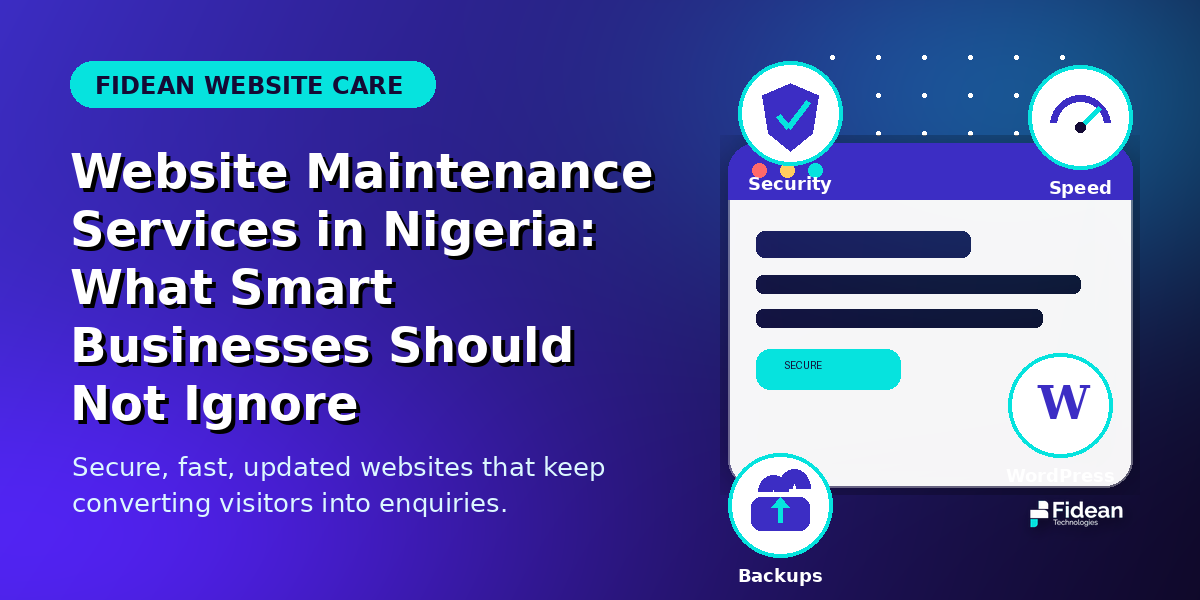
Good maintenance is not just “updating plugins.” That is one small part of the work. Proper business website support should protect the site, keep it fast, keep it accurate, and make sure it continues to support sales, enquiries, recruitment, credibility, or whatever goal the website was built to achieve.
Here are the key parts of a healthy maintenance plan.
1. Backups and restore testing
Backups are your website insurance. But a backup that has never been tested is only a hopeful assumption. A reliable maintenance provider should schedule automatic backups, store them safely, and periodically confirm that the site can actually be restored.
This matters because website issues are not always caused by hackers. A plugin update can break the site. A developer can overwrite the wrong file. A hosting account can be suspended or corrupted. Someone with admin access can mistakenly delete important content. With a clean backup and restore process, recovery becomes manageable instead of chaotic.
2. WordPress, plugin, and theme updates
For many Nigerian SMEs, WordPress is the practical choice because it is flexible, affordable, and widely supported. But WordPress sites need regular updates. The core software, themes, and plugins receive updates to improve features, fix bugs, and patch security vulnerabilities.
The important word is “careful.” Updating everything blindly on a live business site can break layouts, forms, payments, or custom functionality. A good maintenance partner checks backups first, reviews the update risk, applies updates in a controlled way, and tests key pages after the update.
3. Security monitoring and malware cleanup
Website security in Nigeria is a business issue, not just a technical issue. A hacked site can redirect visitors to spam pages, host malicious files, send phishing emails, damage your domain reputation, and trigger search engine warnings.
Basic security maintenance should include strong admin hygiene, login protection, malware scans, firewall configuration where appropriate, file integrity checks, and quick response when suspicious activity appears. For businesses handling enquiries, payments, patient information, student data, or customer records, this is especially important.
4. Speed checks and uptime monitoring
A slow website quietly kills conversions. Many users are browsing on mobile networks, sometimes with unstable connections or limited data. If your homepage takes too long to load, your marketing budget may be sending visitors into frustration.
Maintenance should include periodic speed checks, image optimisation, cache review, hosting performance checks, and database cleanup where needed. Uptime monitoring is also valuable because you may not be the first person to notice your site is down. Your customers might notice before you do.
5. Form testing, analytics, and SEO hygiene
Your website is supposed to do a job. For most businesses, that job includes generating enquiries, receiving bookings, selling products, collecting applications, or building authority. So maintenance should include testing the actions that matter.
Can users submit the contact form? Does the WhatsApp button open the right number? Do quote requests reach the correct email address? Are Google Analytics and Search Console still connected? Are important pages indexed? Are old broken links hurting user experience? These checks are small, but they protect revenue.
For SEO, maintenance may include updating page titles, fixing broken links, improving internal linking, refreshing outdated content, compressing images, and ensuring pages remain crawlable. If your business depends on search traffic, this cannot be an afterthought.
6. Content updates and hosting support coordination
Sometimes maintenance is simply keeping information accurate. New services, price changes, team changes, promotions, location updates, testimonials, case studies, and FAQs should not sit in someone’s WhatsApp chat forever. They should make it to the website.
A good support partner can also coordinate with hosting and email providers when issues arise. For example, if email deliverability fails because DNS records are wrong, the website team should know how to work with the hosting environment, domain registrar, and email service to fix the underlying issue.
For businesses that need reliable hosting alongside maintenance, Fidean can also guide hosting decisions through solutions like FiddyHost and managed support. You can explore website support options through our website maintenance service page at /services/website-maintenance/ or speak with us directly at /contact/.
The real cost of ignoring website maintenance
The cost of neglect is not always visible at first. That is what makes it dangerous. A broken website does not always shout. Sometimes it whispers through lost enquiries, weaker rankings, slower pages, and reduced trust.
Lost enquiries from broken forms
One of the most painful examples is a contact form that looks successful to the customer but does not deliver messages to the business. A clinic may lose appointment requests. A real estate firm may lose inspection bookings. An NGO may miss donor or volunteer enquiries. A school may lose admissions leads during the exact season when every enquiry counts.
If one serious lead is worth hundreds of thousands or millions of naira, then a “small” form issue can become expensive very quickly.
SEO ranking drops from slow or compromised pages
Google wants to send users to pages that are helpful, fast, safe, and accessible. If your site becomes slow, infected, full of broken links, or difficult to crawl, rankings can suffer. Once rankings drop, recovery may take time even after the technical issue is fixed.
For a business that relies on organic search, this can mean fewer calls, fewer WhatsApp messages, fewer quote requests, and a higher dependence on paid ads. In other words, you may end up paying more for traffic because routine website care was ignored.
Trust damage from warnings and outdated content
Trust is fragile online. Visitors make quick decisions based on what they see. If your site still says “Happy New Year 2022,” lists an old office address, shows a staff member who left years ago, or displays broken images, it affects confidence.
For professional services, healthcare, education, finance-related services, and e-commerce, trust is part of the product. A visitor may not separate your website quality from your service quality. If your digital office looks abandoned, they may assume your operations are also disorganised.
Emergency fixes usually cost more
Routine maintenance gives you control. Emergency fixes remove that control. When a website is down, hacked, blacklisted, or breaking during a campaign, the business is under pressure. The fix may require malware cleanup, hosting migration, DNS repair, plugin conflict debugging, reputation cleanup, and urgent communication with customers.
That kind of rescue work usually costs more than monthly maintenance. It is also more stressful. Prevention is not glamorous, but neither is explaining to customers why the payment page is redirecting to a strange website at midnight.
Examples across Nigerian business sectors
A website maintenance plan should reflect how the business actually uses the website.
For an SME service provider, the priority may be lead forms, WhatsApp click tracking, service page updates, Google Business Profile consistency, speed, and monthly reporting.
For a school, maintenance may focus on admissions pages, academic calendar updates, downloadable forms, parent communication links, staff profiles, gallery updates, and uptime during application periods.
For a clinic, trust and accuracy are critical. Doctors’ profiles, appointment forms, phone numbers, service pages, privacy-conscious handling of data, SSL, and security checks matter.
For an NGO, the website may support donations, volunteer recruitment, grant credibility, project reporting, and partner confidence. Broken donation links or outdated impact reports can reduce support.
For an e-commerce business, maintenance is even more operational. Product pages, checkout, payment gateway, stock display, coupon codes, transactional emails, speed, security, and backups must be monitored. If checkout breaks, revenue stops.
For professional firms like law, consulting, architecture, accounting, and training companies, a well-maintained website supports authority. Articles, case studies, credentials, testimonials, and contact pathways must remain fresh and reliable.
The lesson is simple: website maintenance is not only technical. It is commercial.
How to choose a website maintenance partner in Nigeria
Not every “maintenance” offer is equal. Some providers simply log in once a month, click update, and send a vague message saying the site is fine. That is not enough for a business website.
Before paying for support, ask these questions:
- Do you take backups before updates? If the answer is unclear, be careful.
- How often are backups taken and where are they stored? Backups should not live only on the same hosting account.
- Do you test forms, WhatsApp links, checkout, and key pages? Maintenance should protect business actions, not just software versions.
- What is your response time for urgent issues? Know what counts as urgent and what support channel to use.
- What is included and excluded? Monthly maintenance may not include full redesigns, new features, or heavy content uploads unless agreed.
- Who owns website access, domain access, and hosting access? Your business should not be locked out of its own assets.
- Do you provide reports? Reports should show updates, checks performed, issues found, recommendations, and next steps.
- Can you handle security incidents? If malware appears, you need more than motivational quotes.
Also avoid any partner who updates everything blindly without checking compatibility. A careful process matters. WordPress support for SMEs should balance speed, security, backups, and business continuity.
Fidean’s practical approach to maintenance, security, and growth
At Fidean Technologies, our approach to website maintenance services in Nigeria is built around one idea: your website should keep working for the business after launch.
That means we look beyond plugin updates. We help with WordPress maintenance, security checks, speed improvements, hosting coordination, content updates, SEO hygiene, uptime monitoring, form testing, and emergency rescue when things have already gone wrong.
For businesses that already have a website, we can start with a maintenance audit. This helps identify outdated software, weak security points, slow pages, broken forms, missing backups, SSL issues, SEO gaps, and hosting concerns. From there, we can recommend a monthly support plan or a one-time fix depending on what the site needs.
For businesses planning a new website, maintenance should be discussed before launch. The best time to plan backups, security, admin access, analytics, and update routines is before the first public visitor arrives.
A smart website is not just designed well. It is cared for well.
If your website is slow, outdated, hacked, unreliable, or simply unattended, do not wait until customers start noticing the hard way. Request a website maintenance audit through /contact/ or learn more about our support options at /services/website-maintenance/. Your website is part of your business infrastructure. Treat it like something that should keep earning trust every day.