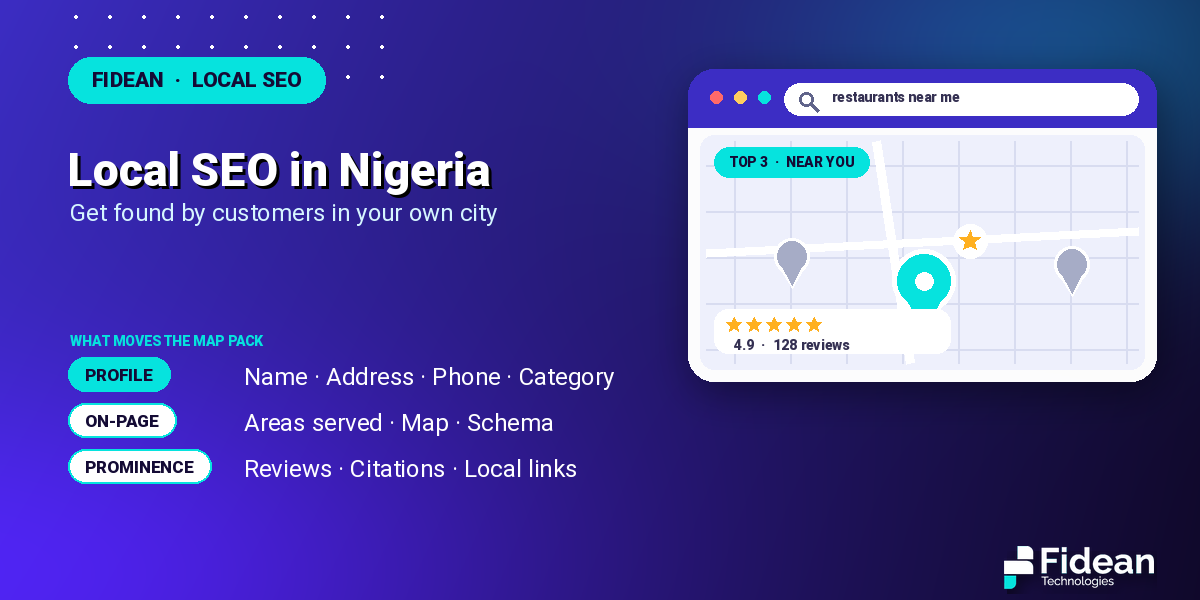
A Lekki restaurant with excellent jollof rice and a website that loads just fine still loses customers every single day. Not because the food is wrong, not because the site is broken — but because it never shows up when someone three streets away types “restaurants near me” into Google. Meanwhile a plumbing outfit in Port Harcourt keeps winning jobs over a rival with a thinner website, simply because that rival did the unglamorous work of local SEO in Nigeria: it told Google, clearly and consistently, who it is, what it does, and exactly where it operates.
That gap — between having a website and being findable — is the most expensive blind spot for Nigerian small businesses right now. This post is a practical playbook you can act on this month, whether you run the site yourself or you are deciding whether to bring in help.
Why “we have a website” is not the same as “customers can find us”
Most business owners treat a website like a shop sign: build it, and people will come. But a website is closer to a shop hidden inside a mall with no directory. Google has to be convinced your business is the right answer for a specific person, in a specific place, right now.
Local search is its own game. When someone searches a phrase with local intent, Google does not show the same ten blue links it shows everyone. It shows three things:
- The Map pack — those three businesses with pins and star ratings sitting at the top of the results.
- The Business Profile panel — the box with your photos, hours, phone number and reviews that appears beside or above the results.
- Localised organic results — normal search results that Google tilts toward businesses near the searcher.
All three are decided mainly by three signals: proximity (how close you are to the searcher), relevance (how well your business matches what they typed), and prominence (how well-known and trusted Google thinks you are). You cannot change your proximity. You can change relevance and prominence — and that is what local SEO is.
Here is why it is worth the effort. Local searches convert far harder than generic ones. Someone typing “SEO services in Nigeria” might be researching. Someone typing “plumber in Ikeja” is not browsing — they have a leak and they are about to call someone. You want to be the one who answers. It is the same momentum behind e-commerce growth in Nigeria: customers now start online, and they expect to find — and trust — a real business near them.
The old generic SEO advice — title tags, keywords, structure — still matters, and you can read our beginner's guide to doing SEO for your website for that foundation. But local SEO adds a layer on top: it is about proving you exist at a place, not just on the internet.
The Google Business Profile is your front door — get it right first
If you do one thing from this post, do this. Your Google Business Profile — the listing that powers the Map pack and the profile panel — is free, and in Nigeria it does more local ranking work than your website does. For most single-location businesses, a perfectly groomed profile on an average website beats a beautiful website with a neglected profile.
“Complete” means more than filling in a name.
- Correct NAP — name, address, phone — matching exactly what is on your website. If your profile says 0803 000 0000 and your site says +234 803 000 0000, fix the mismatch today.
- A verified location. Verification is the step most Nigerian businesses skip. An unverified profile that has been sitting for months is effectively invisible.
- The right primary category. This one field moves rankings more than almost anything else people obsess over. A “restaurant” is not a “caterer”; a “plumber” is not a “building contractor”. Pick the one that matches what you actually sell.
- Service areas. If you travel to customers rather than hosting them — plumbing, cleaning, delivery, repairs — set the areas you genuinely serve. Do not list the whole of Lagos; that reads as spam.
- Opening hours, services and a real description that names your main service and your city in plain language.
Then keep it alive. Nigerian searchers trust listings with recent photos — the shopfront, the team, the actual work. Add a post or an offer every week or two: Google reads freshness as a sign you are still trading.
Reviews are the lever small businesses ignore. Nothing else moves both your prominence and your click-through rate like a steady flow of honest reviews. The simplest Nigerian play: ask by WhatsApp the same day you finish the job, with a short direct link. Reply to every review — including the negative ones — because Google rewards active profiles, and because a calm, professional reply to a complaint is the best advertising money cannot buy.
The mistakes that quietly sink Nigerian listings: a phone number that does not match the website, a duplicate or fake listing fighting your real one, an address still showing the old office after you moved, and a profile left unverified for months. Each one splits or weakens the signals Google uses to trust you.
On-page signals that tell Google where you operate
Your website has to agree with your profile and reinforce the location, not fight it.
Say where you serve — concretely. Add a clear “Areas we serve” section naming the neighbourhoods and cities you genuinely cover: Ogba, Ikeja and Yaba in Lagos; Wuse and Garki in Abuja; GRA and Trans-Amadi in Port Harcourt. Specific beats broad. “We serve Lagos” is weak; “We cover Ikeja, Ogba, Yaba and Surulere” tells Google something it can verify against real searches. Do not paste a list of 200 cities — that reads as spam and dilutes the pages that matter.
Put the service and location in your titles and headings, naturally. “Emergency plumbing in Ikeja, Lagos” is a good page title. “Plumbing, Plumber Lagos, Plumber Ikeja, Cheap Plumber, Best Plumber Nigeria” is a stuffed mess that Google recognises and penalises. Write for the human reading it; the location phrases are the seasoning, not the meal.
Publish your address in the footer and embed a real Google Map on your contact page. A map embed is a quiet trust signal that your address is a real place.
Mark up your business with LocalBusiness schema. Schema is machine-readable code you add to your site that spells out your business name, address, phone, hours and type. You do not see it on the page; Google does. It is the clearest way to hand Google your details in a format it cannot misread.
Create one genuinely useful local page rather than twenty thin ones. A page that answers “how much does a website cost in Nigeria” — we wrote one here — or a case study of a project you completed in Enugu, earns links and citations from real people. Twenty near-identical pages with the city name swapped in earn nothing but a penalty risk.
Local search also rarely works alone. It sits inside a wider growth picture — content, social, email, paid — and we have mapped how those pieces fit together for a Nigerian SME in our digital marketing blueprint.
Do not let your technical foundations quietly cap you. Most local searches in Nigeria happen on a phone, on mobile data, often on a 3G connection in traffic. A site that takes eight seconds to load loses the visitor before your Map pin even matters. HTTPS and a fast mobile experience are not nice-to-haves — they gate how high you can climb.
Citations, links and the prominence signals Google cannot fake
Proximity and relevance are things you configure. Prominence is something you earn — and it is the part that separates businesses that plateau from businesses that dominate their area.
Citations are mentions of your business name, address and phone on other websites: directories, Facebook and Instagram business pages, Bing Places, chambers of commerce, your sector's own directories and associations. Google cross-references these, and what it is really checking is consistency. The same name, the same address, the same number, everywhere. One outdated number on an old directory can split your signals and leave Google unsure which version is real.
Reviews and local mentions do the rest. A mention from a local news site, a supplier, an industry association or a community sponsorship tells Google your business is a genuine part of its area — the kind of thing a fly-by-night operator cannot fake. You do not need to chase hundreds. A handful of real, relevant local mentions build more trust than a thousand generic directory submissions.
And set honest expectations. Local SEO compounds; it is not overnight. If you have never done it, expect to see movement in your profile views and calls within weeks, and real ranking shifts across two to four months of consistent work. Anyone promising page one in a week is either confused or lying.
Doing it yourself vs hiring a local SEO partner
You can absolutely do the first layer yourself — especially if you run one location and can spare a few hours a month.
The DIY path: work through the profile checklist above, add your areas-served section and LocalBusiness schema, fix your speed and HTTPS, then set up a simple routine — a review request after every job, fresh photos and one post a week, and a quarterly review of your listing details. Do that consistently and most single-location businesses make real progress.
When it is worth bringing in help:
- You run multiple locations and need each one handled separately.
- You are in a competitive vertical — real estate, hospitality, healthcare, legal — where the Map pack is fought over hard.
- Your website keeps failing technical checks (slow, insecure, poorly structured) and you do not have the time or appetite to fix it.
- You have no internal capacity to keep content and reviews flowing month after month.
The reality check on the technical side: a local SEO strategy is only as strong as the website under it. If speed, structure and security are failing, no amount of profile polishing will carry you. Often the right first move is fixing the site — see our guide on choosing the right web development company in Nigeria if you are deciding who to trust with it.
What to look for in a partner — and what to be wary of. Ask any provider, including us: What exactly will you change, and how will I see it? How will you report on results, and what access will I keep to my own profile and analytics? Which businesses, in which cities, have you actually moved? Be very cautious of guaranteed “top of Google” promises (nobody controls the algorithm), monthly reports that are just decorative graphs, and tactics that stuff keywords or farm fake reviews. Those are the shortcuts that get profiles suspended.
If you would rather not do this alone, this is exactly the groundwork we do with Nigerian businesses — profile setup, on-page fixes, local content and reporting. You can see past work in our portfolio, and if you would like a second pair of eyes, ask for a free local visibility audit of your Google profile and website — just get in touch.
The bottom line
Local SEO in Nigeria is not a trick, a hack, or a one-off job. It is the steady discipline of telling Google — and the customers using it — the truth about your business clearly and consistently: who you are, what you sell, and exactly where you work. Get the profile right, make the website agree with it, earn a few real mentions and reviews, and keep it alive. Do that for a few months and nearby customers stop finding your competitors and start finding you.