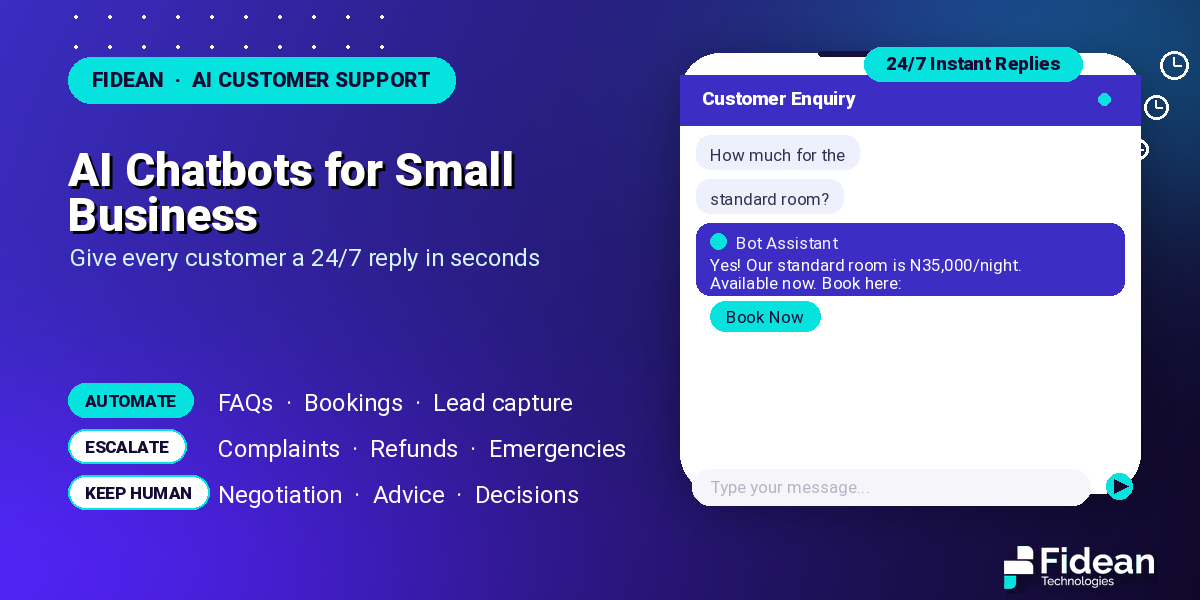
It is 10 PM. A customer in Lagos types “How much for the standard room?” into your website chat. She needs an answer right now — and your receptionist is asleep. An ai chatbot for business nigeria would reply instantly: “₦35,000 for a standard room. Book here →” while continuing to handle five other chats at the same time.
This is the reality most Nigerian SMEs face daily. The same questions — “What time do you open?”, “Do you deliver?”, “How much is this?”, “Is it available?”, “Where are you located?” — arrive hundreds of times a week across WhatsApp, Instagram DMs, and website contact forms. Each one takes a staff member away from real sales work. And the enquiry that goes unanswered for fifteen minutes becomes the competitor's customer. An ai chatbot for business Nigeria is not a futuristic luxury reserved for banks and telecoms. It is a practical tool any SME — a hotel in Victoria Island, a pharmacy in Enugu, a school in Port Harcourt, a boutique on Lagos Island — can deploy in days for a fraction of the revenue it protects.
What a Small-Business AI Chatbot Actually Is (Let's Demistify This)
There is a lot of noise around AI chatbots. If you hear “AI” and picture a sci-fi robot replacing your entire team, pause. A small-business chatbot is nothing that dramatic. It is a conversation engine — a piece of software trained on your business information — that recognises common questions and returns pre-approved answers instantly.
Two types matter for Nigerian SMEs today:
Rule-based / button-flow chatbots. These work with keyword triggers and branching menus. A customer types “pricing” and the bot shows a menu of service packages. The customer taps “Hospitality Suite” and gets the price, feature list, and a link to book a call. These are best for clinics, hotels, and schools with structured services and predictable questions. They are fast, inexpensive, and require almost no ongoing maintenance.
AI / LLM-powered chatbots. These understand natural language — the difference between “how much is the deluxe room?” and “deluxe price” — and can pull answers from your website content, product PDFs, price lists, or Google Drive. They handle variations of the same question without needing every possible wording programmed in advance. Best for e-commerce, real estate agencies, consultancies, and any business where customers ask the same thing in different ways.
Both types are embedded in your website via a chat widget, connected to WhatsApp through the Business API, or run on Instagram and Facebook Messenger. Many businesses start with a WhatsApp AI chatbot for small business because that is where 80 per cent of their customer conversations already happen.
Let us be honest about limits: a chatbot cannot handle voice notes (WhatsApp voice-to-text is not reliable enough yet) or nuanced Pidgin English variations that confuse intent. It should not handle complaints, pricing negotiations, medical advice, or anything requiring empathy and judgment. When a question is complex or emotional, the chatbot hands off to a human seamlessly. The handoff — not the automation — is what preserves trust.
What a Chatbot Should Handle (and What It Must Not Touch)
The golden rule: if your team can answer a question from memory in ten seconds without thinking about it, a chatbot can handle it. Here is what falls into that bucket:
Hours and location. “What time do you open on Saturdays?” “Where is your office?” “Do you operate in Abuja?” These are answered once, stored, and served infinitely.
Pricing and availability. “How much is a standard room?” “Is the two-bedroom flat still available?” “What are your service packages?” Pulled from your rate card or inventory database.
Booking and appointment status. “Can I book for Saturday by 3 PM?” “Is my appointment still confirmed?” Integrated with your calendar or booking system. The chatbot sends a confirmation with directions and an e-ticket.
Payment methods. “Do you take Paystack?” “Can I pay by bank transfer?” “Is POS available?” Links to the payment page or a Paystack payment link generated on the spot.
Lead capture. Name, phone number, email, and what they need — structured and delivered to your sales team as a pre-qualified lead, not a WhatsApp screenshot someone forgot to follow up on.
Order and delivery status. “Has my order shipped?” “When will it arrive?” Pulled from your order management system or a simple lookup.
What a chatbot must NOT handle: price negotiations (“I can pay ₦15k, abeg”), complaints of any kind, medical or therapeutic advice, sensitive customer data (bank details, BVN), or anything the owner would want to handle personally. These go straight to a human, no delay, no bot filter.
A quick test: scroll up in your business WhatsApp group chat and count how many of this week's messages are the same question from different customers. If one question appears more than three times — “How much?”, “Still available?”, “What time?” — that question is ready for automation.
What It Costs and What It Saves (Naira Numbers You Can Take to a Meeting)
The most common objection we hear from Nigerian SME owners is, “Isn't that something only big companies can afford?” It is a fair question, because the chatbots you have experienced — MTN's virtual assistant, UBA's Leo, or GTBank's chat support — were built with enterprise budgets.
A small-business chatbot is a different category entirely — one built specifically as a conversational AI for small businesses, not an enterprise system adapted down.
For a basic FAQ chatbot on WhatsApp and your website, deployed on an existing website, the typical setup cost is ₦250,000–₦600,000 depending on complexity. The monthly AI subscription runs ₦30,000–₦80,000 for a plan that handles thousands of conversations. On top of that, WhatsApp Business API charges per conversation — roughly ₦90 for marketing conversations, ₦52 for utility conversations (appointment confirmations, order updates, service notifications). These numbers are market ranges as of late 2026; the exact cost depends on your enquiry volume and the complexity of your business.
Compare that with staff cost. A customer service representative or receptionist in Lagos costs ₦50,000–₦150,000 per month for a single person working a single shift. A chatbot works three shifts — all of them. It does not replace your receptionist; a chatbot that handles 60 per cent of repetitive enquiries lets that receptionist focus on closing sales and serving walk-in customers rather than typing “Our rates start at ₦25,000” twelve times a day.
The real ROI is not cost savings — it is captured revenue.
Here is a concrete example: a mid-range hotel in Victoria Island receives ten booking enquiries per day on WhatsApp and its website. At a 20 per cent conversion rate, that is two confirmed bookings per day. Now add a chatbot that answers instantly, even at midnight. Four more of those enquiries convert because the response was immediate — the customer did not bounce to the next hotel. At an average room rate of ₦45,000, that is four extra bookings per day, which is ₦180,000 per day in revenue, or roughly ₦5.4 million per month. The chatbot setup and monthly fees are a fraction of that increase.
The same logic applies to a clinic in Enugu that books consultations, a school in Port Harcourt that handles admission enquiries, or a boutique in Lagos that answers “Is this dress in stock?” all day. The tool pays for itself on the first week of captured leads.
How to Get Started in a Week (Not a Quarter)
You do not need a three-month digital transformation project. Here is the path that works for Nigerian SMEs:
Step 1: List the ten most common questions your team handles in a week. Go into your WhatsApp group chat and scroll up. The data is already there. Price questions, location questions, availability questions, delivery questions. Write them down in the words your customers actually use, not the formal version your staff would write.
Step 2: Decide where customers will find the chatbot. Your website? WhatsApp? Instagram? Facebook Messenger? Pick the channel that already has the most traffic and start there. For most Nigerian businesses, that channel is WhatsApp. Adding the website widget comes second.
Step 3: Write simple, correct answers to those ten questions. The chatbot is only as good as the content it serves. A bad answer served instantly is worse than a good answer delivered slowly. Keep responses short, accurate, and consistent with what a human would say.
Step 4: Build the flow. This is where a partner like Fidean handles the technical work — setting up the conversation flows, connecting to WhatsApp Business API, integrating your booking system or Paystack checkout. For a basic setup, expect two to three days.
Step 5: Test with your team. Run the chatbot for a week alongside your normal operations. Audit every handoff — what did the chatbot miss? Where did customers get frustrated? Adjust the answers and flows, then launch properly.
The Bottom Line: Customers Expect Speed, Not Polish
Nigerian customers are surprisingly forgiving of a simple chatbot interface. What they are not forgiving of is silence. A chatbot that answers “Room available — ₦35,000 for standard, ₦55,000 for deluxe — book here:” in three seconds is trusted more than a beautifully designed website form that nobody checks for six hours.
The businesses winning the customer service game in Nigeria today are not the ones with the fanciest technology. They are the ones that reply fastest. An AI chatbot — properly scoped, transparent about its limits, and backed by a real human for the hard conversations — is the most direct path to being that business.
If you are ready to see what a chatbot would look like for your business, we can run a free audit: map your most frequent customer questions, identify which ones are costing you time and missed revenue, and give you a simple deployment timeline. Get in touch — no pressure, no sales pitch. Just the numbers that matter for your business.
P.S. Already building your digital presence? See how chatbots fit into your wider tech stack with our guide on choosing the right web development company in Nigeria, and explore affordable business app development solutions that connect your chatbot to booking, inventory, and payment systems.